By Dr. Noémie Hofman, DVM, CertAqV — WAVMA Certified Aquatic Veterinarian, Dubai
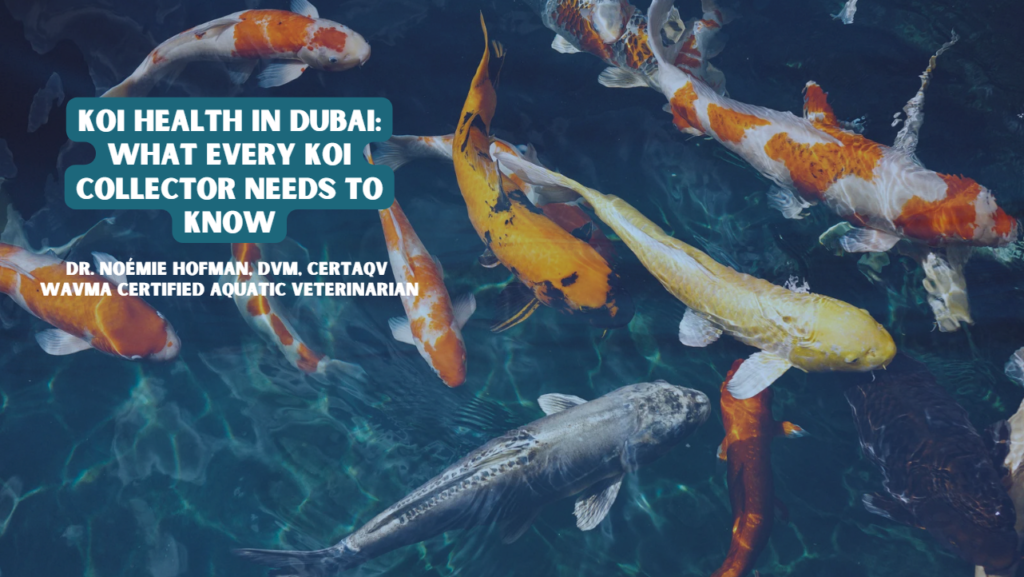
Koi keeping is one of the most serious and financially significant aspects of ornamental fish culture in Dubai. A well-bred, mature koi can be worth tens of thousands of dirhams. Collections of high-grade fish represent investments comparable to fine art or luxury vehicles. Yet the veterinary support available to koi collectors in the UAE has historically been nonexistent.
That is changing. As the only WAVMA Certified Aquatic Veterinarian in Dubai, I provide specialist veterinary care for koi collections of all sizes, from backyard hobby ponds to high-value collector setups. This post covers the most important health considerations for koi kept in Dubai, the diseases most likely to affect your fish, how Dubai’s unique climate creates specific challenges for pond management, and what a koi vet consultation actually involves.
Why Koi Are Different From Other Ornamental Fish
Koi are large, long-lived, and highly valuable. A well-maintained koi can live for 25 to 35 years and reach considerable size. This combination of longevity, size, and value means that health decisions carry more weight than they do with smaller, shorter-lived species.
Koi are also socially, financially, and emotionally significant to their owners in a way that distinguishes them from most other fish species. Many collectors develop genuine bonds with individual fish over years of keeping. The loss of a prized koi is not a trivial event, which is another reason why preventive veterinary care and early intervention matter so much in this context.
From a clinical perspective, koi are relatively robust fish when their environmental needs are properly met. They tolerate a wider range of water parameters than many tropical species. But they are also large enough to carry significant pathogen burdens, and their size means that by the time disease becomes clinically obvious, it has often been developing for a considerable time.
How Dubai’s Climate Affects Koi Health
Dubai’s climate creates a set of challenges for koi pond management that are fundamentally different from those faced by koi keepers in Europe, Japan, or North America. Understanding these challenges is the foundation of good koi husbandry in the UAE.
Summer water temperatures
This is the single most important environmental challenge for koi keepers in Dubai. Koi are temperate fish. Their optimal water temperature range is approximately 15 to 25 degrees Celsius. Above 28 degrees, physiological stress increases significantly. Above 30 to 32 degrees, immune function is compromised, bacterial growth accelerates dramatically, and dissolved oxygen levels drop. Above 35 degrees, mortality risk becomes very serious.
In Dubai, outdoor pond water temperatures in summer can exceed 35 degrees without active cooling. This means that koi keepers in Dubai who maintain outdoor ponds without temperature management are exposing their fish to conditions that would be considered an emergency in any temperate climate. Shade structures, pond depth of at least 1.5 metres, aeration, and in serious collections active cooling systems are not optional in this climate. They are essential.
A koi collection worth significant money that is maintained in an uncooled outdoor pond during a Dubai summer is at genuine risk. Water temperature management is the most important investment a Dubai koi keeper can make.
Rapid temperature fluctuation
Beyond the extremes of summer heat, rapid temperature changes are themselves stressful to koi. In Dubai, the transition between seasons can produce significant day-to-night temperature swings, particularly in autumn and spring. Koi immune function drops significantly during periods of rapid temperature change, which is why disease outbreaks often occur at these seasonal transitions rather than at the temperature extreme itself.
Water quality in the Gulf climate
High ambient temperatures accelerate the biological processes in a pond. Beneficial bacteria in the filter work faster, but so do pathogens. Algae grows more aggressively. Organic matter breaks down more quickly, placing greater demands on filtration. Evaporation rates are high, which means top-up water is added more frequently and needs to be properly treated before addition. A filtration system sized for a European climate may be undersized for the same pond volume in Dubai.
The Most Common Koi Diseases in Dubai
Bacterial ulcer disease
Ulcer disease caused by Aeromonas and Pseudomonas species is the most common clinical presentation in koi. It begins as a small red or haemorrhagic spot on the skin, often dismissed initially as a minor injury. Left untreated, the lesion deepens, the surrounding tissue becomes necrotic, and the ulcer can penetrate through the musculature to expose internal organs. At this stage the prognosis is significantly worsened.
Early identification and prompt treatment with appropriate antibiotics, determined by culture and sensitivity testing, gives the best outcomes. Wound debridement, topical treatment, and environmental correction are all components of the treatment protocol. In Dubai’s warm water temperatures, bacterial growth is faster than in cooler climates, meaning the progression from early lesion to advanced disease can occur in days rather than weeks.
Koi Herpesvirus (KHV)
Koi Herpesvirus is one of the most feared diseases in koi collections worldwide. It is a highly contagious viral disease of koi and common carp with mortality rates that can approach 100 percent in affected populations. There is no effective treatment once clinical signs appear.
KHV is temperature dependent, with clinical disease most commonly occurring when water temperatures are between 16 and 28 degrees Celsius. In Dubai this corresponds to the cooler months of the year. Fish that survive a KHV outbreak often become lifelong carriers, capable of transmitting the virus to naive fish under conditions of temperature stress or immunosuppression.
The only effective protection against KHV is a rigorous quarantine protocol for all new fish entering a collection and sourcing fish from reputable suppliers with known health screening programmes. A single unquarantined new fish introduced to an established collection is all it takes to potentially devastate that collection. This is a point that cannot be emphasised strongly enough to Dubai koi collectors who regularly purchase fish from international suppliers.
Parasitic infestations
The most clinically significant parasites in koi are gill flukes (Dactylogyrus species), body flukes (Gyrodactylus species), anchor worm (Lernaea), fish lice (Argulus), and various protozoal parasites including Trichodina, Chilodonella, and Costia. These are all common in koi collections and some are introduced with almost every new fish purchase if quarantine is not practised.
Gill parasites are particularly dangerous because they cause respiratory distress that can be fatal at high burdens. Early signs include flashing, increased breathing rate, surface gathering, and reduced activity. Skin scrapes and gill biopsies examined under microscopy are necessary to identify the specific parasite and select the appropriate treatment. Most antiparasitic treatments require precise dosing based on pond volume and water temperature. Incorrect dosing is both ineffective and potentially toxic.
Swim bladder disorders
Swim bladder problems present as buoyancy abnormalities, with affected fish unable to maintain normal position in the water. They may float at the surface, sink to the bottom, or swim at a persistent angle. In koi, swim bladder disorders can have multiple causes including bacterial infection, physical trauma, parasitic cysts, neoplasia, and congenital abnormalities. Accurate diagnosis requires imaging and in some cases surgical exploration. This is one of the conditions where fish surgery provides genuine clinical benefit and where it is essential you have access to a specialised veterinarian able to intervene effectively.
Nutritional conditions
Koi fed exclusively on commercial pellets without variety, or fed pellets of poor nutritional quality, develop deficiencies over time. Vitamin C deficiency causes immune suppression and skeletal deformities. Vitamin E deficiency is associated with muscular dystrophy. Improper protein to energy ratios in the diet affect growth and organ function. Dietary assessment is part of every koi health consultation.
Quarantine: The Most Important Thing You Can Do
Quarantine of new fish before introduction to an established collection is the single most effective disease prevention measure available to koi collectors. It is also the most frequently skipped.
A proper quarantine protocol involves isolating new fish in a separate system for a minimum of four to six weeks, monitoring for signs of disease, treating for common parasites where appropriate, and ideally conducting veterinary health screening including gill biopsies and where indicated KHV testing before the fish joins the main collection.
In Dubai, where koi are frequently imported from Japan, Israel, and other international breeding centres, the quarantine step is not a cautious option. It is a clinical necessity. The cost of a proper quarantine setup and health screening is small compared to the cost of losing an established collection to a disease introduced by a single unscreened fish.
What a Koi Vet Consultation Looks Like
A koi veterinary consultation begins well before the examination of the fish. The history of the collection, recent purchases, water parameter records, feeding regime, filtration system, and any previous health events are all clinically relevant. In koi medicine, as in all aquatic medicine, the environment is part of the patient.
Water testing covers temperature, pH, ammonia, nitrite, nitrate, dissolved oxygen, and salinity if relevant. Physical examination of affected fish is conducted with sedation where appropriate to allow thorough assessment without causing stress. Skin scrapes, gill biopsies, and cytology provide rapid diagnostic information. Where bacterial infection is suspected, samples are submitted for culture and antibiotic sensitivity testing.
Where surgical intervention is indicated, koi can be safely anaesthetised and operated on. Fish anaesthesia is a routine part of aquatic veterinary practice when performed by a qualified clinician. Procedures including ulcer debridement and treatment, surgical removal of cysts and tumours, swim bladder surgery, and wound repair are all within the scope of aquatic veterinary medicine.
Preventive Health Care for Koi Collections
The most cost-effective approach to koi health management is preventive rather than reactive. For a collection of any significant value, an annual health check with a qualified koi vet provides early identification of developing problems, water quality assessment, dietary review, and parasite screening before problems become clinical emergencies.
In Dubai specifically, a pre-summer veterinary assessment to ensure the collection is in optimal condition before the heat stress period, and a post-summer check once temperatures normalise, represents a sensible health management schedule for serious collectors.
If you have a koi collection in Dubai and would like to discuss veterinary support, preventive health screening, or have an urgent concern about one of your fish, get in touch through the contact page.

Dr. Noémie Hofman is the only WAVMA Certified Aquatic Veterinarian in Dubai and sees koi patients from collections of all sizes and values.