By Dr. Noémie Hofman, DVM, CertAqV — WAVMA Certified Aquatic Veterinarian, Dubai
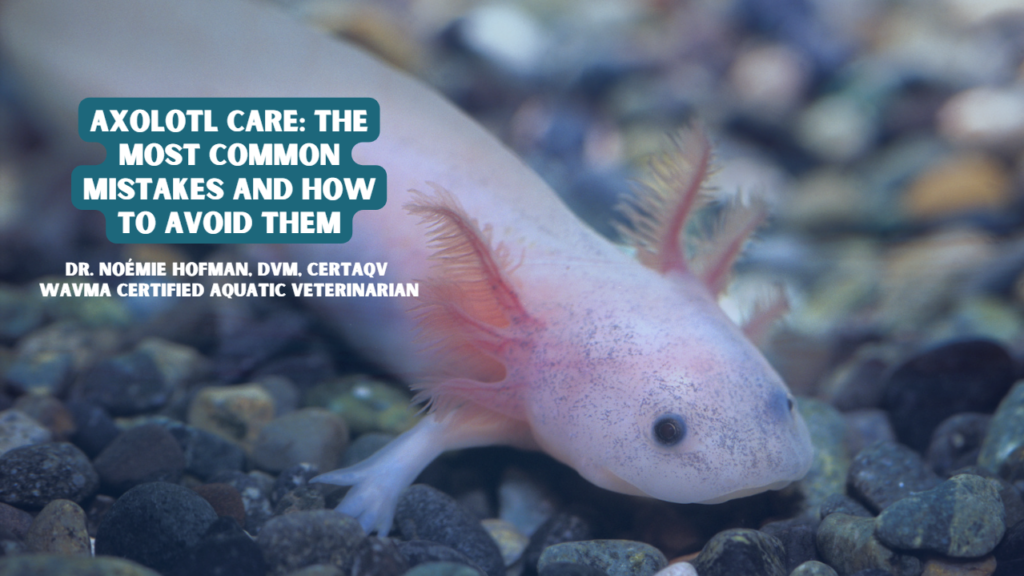
Axolotls have become one of the most popular exotic aquatic pets over the past few years. Their unusual appearance, relative docility, and reputation as low-maintenance animals have made them appealing to a wide range of owners, including many who have never kept an aquatic species before.
The low-maintenance reputation is where the problem starts. Axolotls are not low-maintenance animals. They are one of the most environmentally sensitive aquatic species kept as pets, with a narrow range of acceptable water conditions and a physiology that makes them highly susceptible to stress-related illness. Keeping an axolotl healthy requires consistent active management that most new owners are not prepared for when they bring one home.
As the only WAVMA Certified Aquatic Veterinarian in Dubai, I see axolotl patients regularly. The vast majority of cases I encounter are the result of the same handful of preventable husbandry mistakes. This post covers what those mistakes are, how to recognise when your axolotl is unwell, and what veterinary care looks like for this species.
What Is an Axolotl and Why Is It Clinically Unique?
The axolotl (Ambystoma mexicanum) is a neotenic salamander, meaning it retains its larval characteristics throughout its entire life. Unlike most amphibians that undergo metamorphosis and move onto land as adults, the axolotl remains permanently aquatic and retains its external gills, which are the feathery structures visible behind its head. These external gills are a primary indicator of health status that experienced owners and vets monitor closely.
Axolotls are native to the lake complex of Xochimilco near Mexico City, an environment characterised by cool, clean, well-oxygenated freshwater. They are critically endangered in the wild, with wild populations now functionally extinct in many of their former habitats. The animals kept as pets are captive-bred descendants of a relatively small founder population, which has implications for their genetic diversity and disease susceptibility.
From a veterinary perspective, axolotls present unique clinical challenges. Their skin is extremely permeable, meaning they absorb substances from their water directly. Any chemical contaminant, incorrect water treatment, or medication applied without understanding axolotl-specific pharmacology can cause rapid and severe harm. They are also remarkably stoic, showing very few behavioural signs of illness until a condition is quite advanced.
The Most Common Axolotl Husbandry Mistakes
Mistake 1: Water that is too warm
This is by far the most common and most clinically significant problem I see in axolotl patients. Axolotls require water temperatures between 14 and 20 degrees Celsius. Above 22 degrees, physiological stress begins. Above 24 degrees, immune function is significantly compromised and the risk of bacterial and fungal infection rises dramatically. Above 26 degrees, the situation becomes critical and mortality is a real risk.
In Dubai, tap water and room temperature water sit well above these thresholds for most of the year. An axolotl kept in a tank with no active cooling in a Dubai apartment is being kept in conditions that are chronically stressful at best and acutely dangerous at worst. Maintaining an axolotl in Dubai requires either a dedicated aquarium chiller or a very carefully managed air-conditioned room with the tank positioned away from any heat sources.
If your axolotl tank water is above 20 degrees Celsius, your axolotl is under thermal stress regardless of how healthy it appears. This is the single most important parameter to get right.
Mistake 2: An uncycled tank
New tank syndrome is the cause of a significant proportion of early axolotl deaths. A newly set up aquarium has no established colony of beneficial bacteria to process the ammonia produced by the axolotl’s waste. Without these bacteria, ammonia accumulates rapidly, causing gill damage, skin irritation, and eventually fatal toxicity. This process is called cycling, and a tank needs to be biologically cycled before any axolotl is introduced.
Cycling a tank takes four to six weeks in general. Many owners skip this step entirely or are not told about it by the seller. The result is an axolotl placed into water with rising ammonia levels, showing signs of stress within days and often presenting as seriously ill within one to two weeks of purchase. Daily water parameter testing in a new tank is essential. Ammonia should be at zero and nitrite should be at zero before an axolotl is introduced.
Mistake 3: Inappropriate tank mates
Axolotls are not community animals in the conventional sense. They will attempt to eat anything that fits in their mouth and will be nibbled by fin-nipping fish species. Common mistakes include keeping axolotls with tropical fish, goldfish, or other axolotls of significantly different sizes. Axolotl limb and gill regeneration is a well-documented biological phenomenon, but relying on it as a management strategy for tank mate injuries is not acceptable husbandry. Gill damage from nibbling impairs respiration and increases infection risk significantly.
Mistake 4: Gravel substrate
Axolotls are bottom-dwelling animals that spend significant time resting on and moving across the tank floor. Fine gravel in the 2 to 10 millimetre range is actively dangerous because axolotls will ingest it while feeding, leading to gastrointestinal impaction. This is a genuine emergency requiring veterinary intervention and in severe cases surgical removal. The safest substrate options are fine sand, which passes through the digestive system without causing obstruction, or bare-bottomed tanks. Large smooth stones that cannot be ingested are also acceptable.
Mistake 5: Overfeeding and poor diet
Axolotls are voracious feeders and will consume food whenever it is offered. Overfeeding leads to excess organic waste, which drives ammonia spikes and deteriorating water quality. Adult axolotls need to be fed every two to three days, not daily. Uneaten food should be removed within a few hours.
Dietary variety is also important. Axolotls thrive on a diet of earthworms, bloodworms, and appropriately sized pellets formulated for axolotls or large carnivorous fish. Feeding exclusively on one food type over an extended period leads to nutritional deficiencies that manifest as immune suppression, poor gill condition, and skin problems.
How to Read Your Axolotl’s Gills
The external gills of an axolotl are one of the most reliable indicators of health status available to an observant owner. Learning to read gill condition is one of the most useful skills an axolotl keeper can develop.
Healthy gills
Healthy axolotl gills are full and bushy, with well-developed gill filaments that give them a feathery appearance. In a healthy, relaxed axolotl the gills should be held naturally away from the body. The colour in leucistic or albino axolotls should be pink to red, reflecting good blood oxygenation. In darker coloured morphs the gills should be richly pigmented and full.
Signs of gill deterioration
- Gill filaments becoming thin, sparse, or curling forward toward the face — often indicates poor water quality, high temperature, or bacterial infection
- Gills held flat against the body or curling backward — can indicate stress, low oxygen, or ammonia toxicity
- Discolouration of the gills including paleness in normally pink gills — may indicate anaemia, infection, or systemic illness
- White fluffy growth on the gills — fungal infection, most commonly Saprolegnia, often secondary to bacterial damage or physical injury
- Red streaking or haemorrhage in the gill tissue — serious bacterial infection or water quality crisis requiring immediate attention
Gill deterioration in axolotls is a sign that something is wrong with either the water quality or the animal’s health. It should never be dismissed as normal variation. The earlier gill changes are identified and the cause addressed, the better the outcome.
Common Axolotl Illnesses
Bacterial infections
Bacterial disease is the most common clinical presentation in axolotl patients. It manifests as skin ulceration, reddening of the limbs or body, gill deterioration, lethargy, and anorexia. Aeromonas and Pseudomonas species are frequent causative agents. In Dubai’s ambient temperatures, even brief periods of water temperature above the acceptable range create conditions where opportunistic bacteria flourish rapidly.
Treatment requires accurate bacterial identification and sensitivity testing. Over-the-counter treatments are frequently inappropriate for axolotls given their permeable skin and sensitivity to many common aquatic medications. A number of treatments that are safe for fish are toxic to axolotls. Veterinary guidance is essential before any medication is applied to an axolotl tank.
Fungal infections
Saprolegnia fungal infection appears as white or grey cotton-like growth on the skin, gills, or limbs. It almost always indicates an underlying problem: a wound, bacterial damage, or immune suppression from poor water quality or thermal stress. Treating the fungus without addressing the underlying cause leads to recurrence. Salt baths at very low concentrations are sometimes used as a supportive measure but axolotl-specific dosing guidance is essential as they are sensitive to salinity.
Gastrointestinal impaction
As described above, ingestion of gravel or other substrate material is a genuine emergency in axolotls. Signs include loss of appetite, abdominal swelling, floating or buoyancy abnormalities, and progressive lethargy. Diagnosis can often be confirmed with radiography. Mild cases may resolve with supportive care and refrigeration therapy, which slows metabolism and can help passage of the obstruction. Severe cases require surgical intervention under anaesthesia.
Metabolic bone disease
Axolotls kept on poor diets or without adequate calcium and vitamin D3 develop metabolic bone disease, manifesting as skeletal deformities, jaw abnormalities, difficulty feeding, and limb weakness. This is a chronic condition that develops over months and is often not recognised until it is well established. Dietary correction and supplementation can halt progression but cannot reverse existing skeletal changes.
When to Contact an Axolotl Vet
Contact a veterinarian familiar with axolotls if you observe any of the following:
- Loss of appetite lasting more than one week
- Significant gill deterioration that does not improve with water quality correction
- Visible wounds, ulcers, or fungal growth
- Floating or inability to maintain position in the water
- Swollen abdomen
- Limb abnormalities beyond minor tip regeneration
- Lethargy to the point where the axolotl does not respond to food or stimulus
- Any suspected ingestion of gravel or substrate
Axolotls are remarkably resilient animals when their environmental needs are met correctly and illness is identified and treated promptly. The combination of their stoicism in showing pain and the frequently incorrect husbandry information available online means that many owners seek help later than they should. If in doubt, contact a vet.
A Note on Finding Veterinary Care for Axolotls in Dubai
Axolotls are not a species that every veterinary clinic in Dubai is equipped to assess and treat. Their unique physiology, their sensitivity to medications, and the specialist knowledge required for their clinical management means that a vet with genuine aquatic animal experience is needed.
Dr. Noémie Hofman is the only WAVMA Certified Aquatic Veterinarian in Dubai and has clinical experience treating axolotls alongside a full range of aquatic and exotic species. If your axolotl is unwell or you have concerns about its care and setup, get in touch through the contact page.
For axolotl health concerns or a full aquatic husbandry assessment, contact Dr. Noémie through the contact page.