By Dr. Noémie Hofman, DVM, CertAqV — WAVMA Certified Aquatic Veterinarian, Dubai
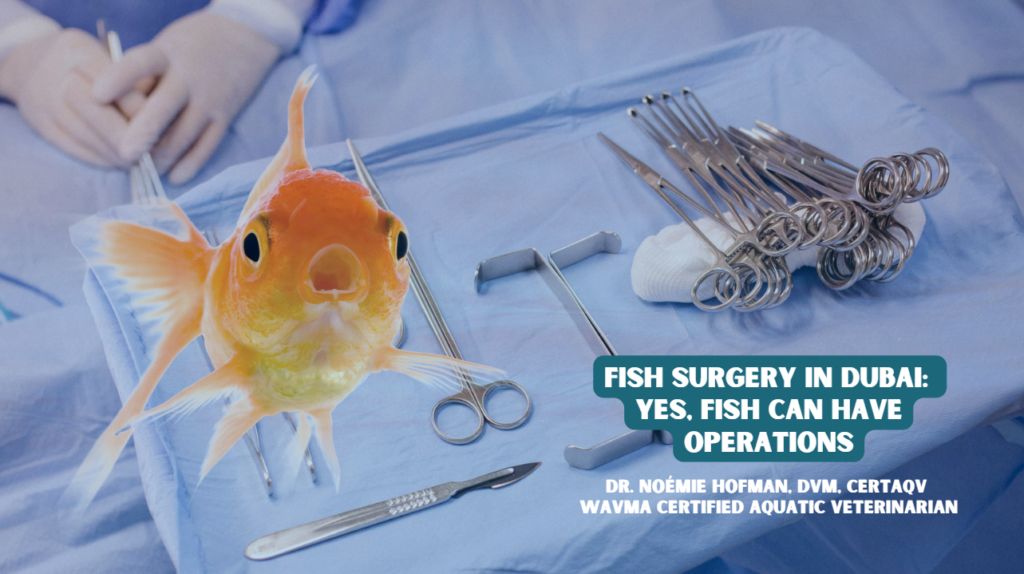
When most people hear the words fish surgery, their first reaction is disbelief. Fish are often thought of as simple animals with little capacity for pain or complex medical intervention. This perception is not only inaccurate but has historically led to significant unnecessary suffering in aquatic patients whose conditions were treatable but went untreated simply because their owners or vets did not know surgery was an option.
Fish surgery is an established and growing field of veterinary medicine. Fish can be safely anaesthetised, operated on, and recovered from surgical procedures with outcomes that are genuinely comparable to soft tissue surgery in other species when performed by a qualified clinician. The main limitation has never been the biological feasibility of the procedures. It has been the scarcity of vets with the training and experience to perform them.
As the only WAVMA Certified Aquatic Veterinarian in Dubai, I perform surgical procedures on fish and aquatic species as part of my clinical practice. This post explains how fish anaesthesia works, what surgical conditions can be treated, what the recovery process looks like, and how to know when your fish might benefit from surgical intervention.
Do Fish Feel Pain?
This question matters clinically and ethically. The evidence base has shifted considerably over the past two decades. Fish possess nociceptors, the specialised sensory neurons that detect tissue damage, and they have been demonstrated to produce physiological and behavioural responses to noxious stimuli that are consistent with pain perception. They produce endogenous opioids in response to injury, and administration of analgesic drugs modifies their response to painful stimuli in ways that parallel what is observed in mammals.
The scientific consensus has moved toward accepting that fish experience something functionally equivalent to pain, even if the neurological substrate differs from mammalian pain processing. From a veterinary ethics perspective, this means that fish deserve appropriate anaesthesia and analgesia during surgical procedures, not because we are certain their experience is identical to that of a dog or cat, but because the available evidence suggests they are not indifferent to it.
Pain management is a standard component of every surgical procedure performed on fish patients. Appropriate anaesthesia, intraoperative analgesia, and post-operative pain assessment are not optional extras in aquatic surgery. They are fundamental to the procedure.
How Fish Anaesthesia Works
Fish anaesthesia is fundamentally different from mammalian anaesthesia because fish breathe water rather than air. The anaesthetic agent is delivered dissolved in the water the fish is immersed in, absorbed across the gill membranes, and produces a dose-dependent progression from sedation through surgical anaesthesia.
The procedure works as follows. The fish is placed into a container of water containing the anaesthetic agent at an appropriate concentration for the species and the procedure. Within minutes, depending on the species, water temperature, and concentration, the fish progresses through stages of sedation to full surgical anaesthesia, characterised by loss of equilibrium, cessation of opercular movement, and loss of response to stimulation. During surgery, the fish is kept moist and oxygenated, typically by irrigating the gills continuously with anaesthetic-maintained water. Recovery is achieved by transferring the fish to fresh, clean, well-oxygenated water, where the anaesthetic is cleared across the gill membranes and normal opercular movement and righting reflex return.
Species-specific knowledge is critical for safe fish anaesthesia. Anaesthetic concentration, induction time, depth assessment, and recovery management vary significantly between species, and between individual fish of different sizes and health status. What is safe for a healthy koi may be inappropriate for a small tropical species or an immunocompromised patient. This is one of the key reasons why fish surgery should only be performed by a clinician with specific aquatic veterinary training.
Surgical Procedures Available for Fish in Dubai
Tumour and mass removal
Cutaneous and subcutaneous masses, including fibrosarcomas, lipomas, and other neoplastic growths, are among the most common surgical indications in fish. Masses that impair swimming, feeding, reproduction, or that are at risk of ulceration and secondary infection are candidates for surgical removal. The procedure involves excision of the mass under general anaesthesia with appropriate wound closure. Histopathology of removed tissue provides information about the nature of the mass and the likelihood of recurrence.
Koi are particularly prone to developing cutaneous masses, and in a valuable fish, surgical removal of a growing mass is a straightforward decision that can significantly extend healthy lifespan.
Coelomic surgery
The coelom is the body cavity of fish, equivalent to the abdominal cavity in mammals. Coelomic surgery allows access to internal organs and is indicated for conditions including egg binding in female fish unable to spawn normally, internal tumours or cysts, gastrointestinal foreign body removal, and internal abscess drainage. Coelomic surgery is more technically demanding than surface procedures and requires a skilled aquatic surgeon, but it is performed routinely in specialist aquatic practice and can be life-saving in appropriate cases.
Egg binding, also called dystocia or retained eggs, is a genuine emergency in female fish and is more common than many owners realise. Affected fish show abdominal swelling, lethargy, and loss of appetite. Without intervention the condition is fatal. Depending on the presentation, treatment may involve medical management, manual expression under sedation, or surgical intervention.
Swim bladder surgery
The swim bladder is the gas-filled organ that allows fish to control their buoyancy. Swim bladder disorders presenting as buoyancy abnormalities are a common complaint in ornamental fish and have multiple causes including bacterial infection, parasitic cysts, neoplasia, and physical trauma. Where the cause is a physical obstruction or cyst that can be accessed surgically, intervention can restore normal buoyancy and significantly improve quality of life. Swim bladder surgery requires precise technique and species-specific anatomical knowledge.
Wound debridement and ulcer treatment
Advanced bacterial ulcers in koi and other ornamental fish that have penetrated deeply into the musculature or have failed to respond to medical management alone are candidates for surgical debridement under anaesthesia. The procedure involves careful removal of necrotic tissue, thorough cleaning of the wound bed, and in some cases placement of topical antibiotic preparations directly into the wound before closure or management as an open wound. Surgical debridement combined with targeted antibiotic therapy based on culture and sensitivity results gives significantly better outcomes than antibiotic treatment alone in advanced ulcer disease.
Ocular procedures
Eye conditions in fish including cataracts, trauma, severe infections, and ocular masses are sometimes managed surgically. Enucleation, the removal of a severely damaged or diseased eye, is a procedure that eliminates a chronic source of pain and infection. Fish manage remarkably well following enucleation and the procedure is generally well tolerated. Less commonly, other ocular interventions are performed depending on the specific presentation.
Fin and scale repair
Severe fin and scale damage from trauma, aggression, or advanced fin rot that has destroyed significant tissue sometimes benefits from surgical debridement and management to promote healthy regrowth. Fish have a remarkable capacity for tissue regeneration, but this capacity is best expressed when the wound is clean, free of necrotic tissue, and the fish’s overall health and water quality are optimised.
Which Fish Can Have Surgery?
In principle, most fish species can be anaesthetised and operated on. In practice, surgical candidacy is assessed on a case-by-case basis taking into account the species, the size of the fish, the overall health status, the nature and severity of the condition, the prognosis with and without surgery, and the experience and equipment available.
The best surgical candidates are fish that are otherwise in good health, are large enough for safe anaesthesia and instrumentation, and have a condition with a clearly defined surgical solution and a realistic expectation of recovery. Very small fish present greater technical challenges. Fish that are severely debilitated or have advanced systemic disease carry higher anaesthetic risk. These factors are discussed openly with owners before any surgical decision is made.
Koi are among the most commonly operated fish in specialist aquatic practice because their size makes them technically accessible, their value makes surgical investment logical, and their owners are generally highly motivated to provide the best possible care. Goldfish, large cichlids, and other sizeable ornamental species are also reasonable surgical candidates for appropriate indications.
Recovery After Fish Surgery
Recovery from fish surgery begins the moment the fish is transferred from the anaesthetic solution to fresh, clean, oxygenated water. Normal opercular movement typically resumes within minutes. Full recovery of equilibrium and righting reflex follows over the next few minutes to half an hour depending on the depth of anaesthesia and the species.
Post-operative management is an important component of outcomes. Water quality must be optimal during recovery. Appropriate antibiotic coverage is provided where indicated. Analgesic agents are used in the peri-operative period. Wound care protocols vary by procedure and are discussed with owners at the time of discharge. Most fish are eating again within a few days of surgery when recovery is uncomplicated.
The remarkable regenerative capacity of fish means that many surgical wounds heal faster than equivalent wounds in mammalian patients. Scale and fin regrowth begins within weeks of injury resolution. With appropriate post-operative care, most fish that are good surgical candidates do well following intervention.
Is Surgery the Right Option for My Fish?
This is a genuinely individual question that depends on the species, the condition, the fish’s overall health, the likely outcome with and without surgery, and the owner’s circumstances. There is no universal answer and any vet who gives one without a thorough clinical assessment is not giving you the right answer for your specific situation.
What can be said with confidence is that the decision should not be made on the assumption that fish cannot have surgery, that surgery is not worth it for a fish, or that nothing can be done. All of those assumptions are outdated and incorrect. Fish surgery is a real option for real conditions in real fish, performed by a qualified aquatic veterinarian with the training and experience to do it safely.
If you have been told that nothing can be done for your fish, or that surgery is not possible, it is worth getting a second opinion from a WAVMA Certified Aquatic Veterinarian before accepting that conclusion.
If your fish has a condition you think might benefit from surgical intervention, or if you have been told treatment is not possible and want a second opinion, get in touch through the contact page.

Dr. Noémie Hofman is the only WAVMA Certified Aquatic Veterinarian in Dubai and provides surgical services for fish and aquatic species as part of her clinical practice.